A Great Victory
True story of an angler who faced Uraima Falls and landed a 32-pound payara.
It all started a few months ago. I was already used to peacock bass fishing in southern Venezuela, in the reservoirs of Guarico State, and I was thinking about visiting other places to explore and enjoy this fantastic activity. Casually, my friend Rafael called me one day at the office to tell me that there was a place in Bolivar State where you could find payaras of enormous size like nowhere else in the world. Of course, at first I thought it was just another emotional story from my friend Rafael, as is common in the world of sport fishermen.
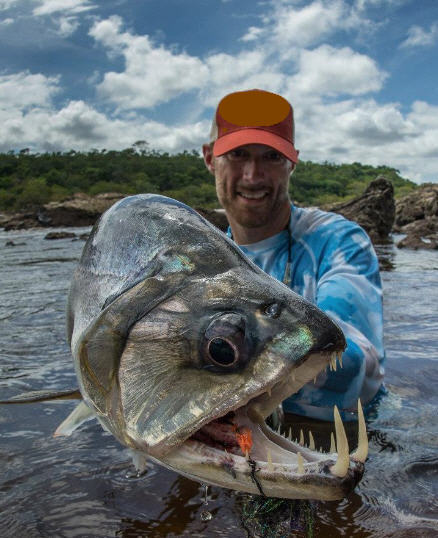
I paid little attention to the comment and continued with my work since they were days of intense labor. About a week later I received an email from Rafael with a photograph attached. The subject of the email was "25-Pound Payara!". My curiosity activated in seconds and when I saw the photo of a silver fish with enormous fangs the thickness of my thumb coming out of its jaws, I was completely paralyzed. I had never seen a payara of such dimensions before; of course I had caught payaras in some parts of the Orinoco River, but never anything that resembled this beautiful specimen. I immediately called Rafael to tell me about the photo and he dedicated himself to telling me the details of how some acquaintances had fought one of the greatest freshwater fishing battles of their lives in the turbulent waters of Uraima Falls (Paragua River). His friends had never lost so many lures and line in a single fishing trip. They confessed to being incredulous about the stories, and then reality took them by surprise and many of them came out defeated by a specimen that proved superior. In short, their fishing trip to Uraima Falls turned into a great battle for which they were not prepared, and only a few anglers managed to land decent specimens. Among them was the 25-pound payara whose photograph he had sent me and which I still looked at with skepticism. After a conversation of more than 15 minutes I had heard enough and I abruptly interrupted Rafael and told him: make all the preparations and organize a fishing trip to this place. From that moment on, only the idea of this phenomenal adventure orbited in my mind.
Rafael did an excellent job. Two weeks later we were ready to set off on the trip and we found ourselves at our final destination, the Uraima Falls camp, something I never thought could exist in such a remote and solitary place.
Slowly the boat approached the shore and we were able to get off to enjoy a very emotional moment. We arrived at the place where the story of giant payara fishing had been born, and now it was our turn to be part of it. I felt I already belonged to this legend that had been forged over the years, and that I didn't know, but of which we had suddenly become its protagonists.
We entered the camp. The welcome with a couple of Cuba Libres, a cozy rustic room in the Churuata style with a fairly cool climate, stories of past battles from the camp staff along with the record book and all the decoration and photographs that referred to the fishing of the place, brought a single thought to my mind: the action was about to begin and things were more serious than I imagined. I felt like a rookie soldier about to go into combat; although I was well equipped, I didn't know if what I had would be enough. Rafael kept preparing everything and the desire to face the turbulent waters we had seen on arrival dominated us. Everything was prepared for the action and we would have only two days to demonstrate what the result of this exciting and anticipated fishing trip would be.
After a while we went to sleep. The silence and a starry sky opened the way for my imagination, waiting for the next day to arrive, when our great encounter would begin. Everything was prepared, it was just a matter of hours.
Very early we got up after a pleasant sleep and after a very good breakfast, we were assigned a captain and a fishing guide, experts in the place, and so we boarded a 5-meter-long curiara, with its respective swivel seats, in search of the famous and devilish payara of Uraima Falls.
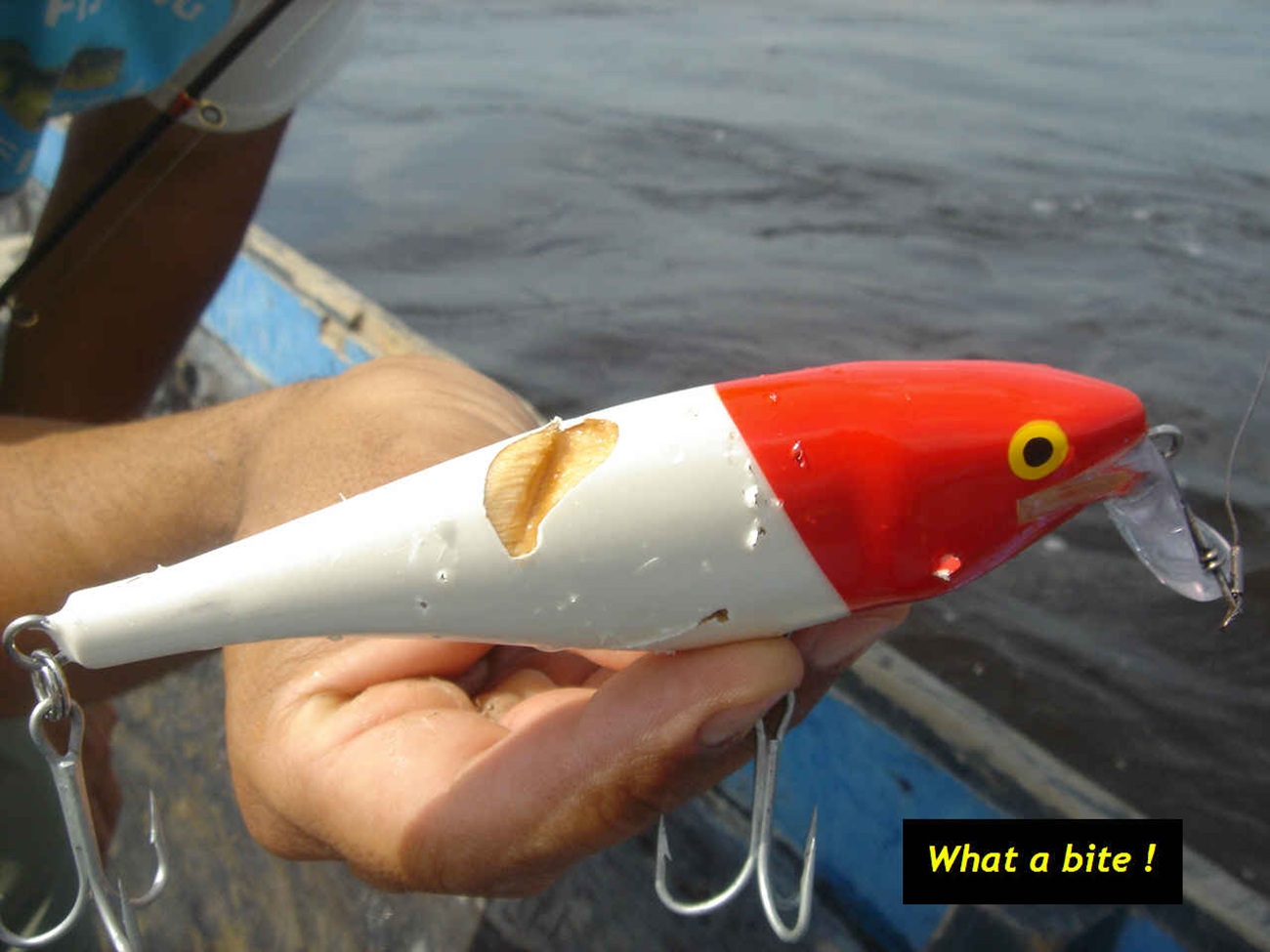
Our fishing guide Luis and the captain were ready in their positions inside the boat and we dedicated ourselves to trolling in an area that the guide recommended. Rafael and I cast our respective lures, in this case we were using deep-diving Rapala CD 18s. I immediately felt the lure take depth quickly, helped by the boat's movement and the strong river current. We were practically going around in circles at the base of the falls, water splashed into the boat, my face was wet and you could feel the force with which the water crashed against the curiara; the whirlpools were enormous. I didn't believe it was possible to fish for anything in such turbulence. We stayed there for about half an hour without any luck, and suddenly Rafael's rod had an impressive strike. The sound of the reel was intense as yards and yards of line shot out; I had never seen anything like it in freshwater fishing. Rafael pumped the rod twice with force and we could see in the distance a silver body that jumped like a sailfish in the waters of the Paragua River. We were astonished by the spectacle. Luis shouted desperately "PAYARA PAYARA!" The captain skillfully positioned the curiara parallel to where the Payara was pulling. Rafael couldn't get out of his state of surprise and quickly adjusted the reel's drag, since the line kept coming out at great speed. The Payara took depth and you could see how his stiff rod worked forcefully; I just hoped the 40-pound line wouldn't give way. Suddenly and to our surprise, the payara shot out into the air like a projectile from the bottom of the river, thrashing from side to side, and before our eyes we could see the Rapala detach from the mouth of this ferocious fish. It was a moment that was engraved in my memory like a photograph. At that instant we realized that the battle had begun.
After this first encounter, spirits were higher and Rafael writhed in the curiara for having lost his first payara at Uraima Falls. We continued trolling in the same area and agreed to try another spot after lunch. Going to eat and coming back was no big deal since the fishing spots are just 5 minutes from camp. However, Luis suggested a sudden change, and this time we pulled up near some rocks to do some spinning at the base of the rapids. The view was intimidating; you could feel the vibration in the rocks caused by the powerful torrent of water just a few meters from our position. My shirt flapped in the air current and the noise of the water forced us to shout to hear what we were saying. We had to switch lures to Rapala CD 14 to be able to cast them easily. It was really exhausting work casting against that flow of water; I still couldn't understand how a fish could hunt in such chaos, but once again nature proved that I was wrong. I felt an enormous attack on my rod, I almost fell into the river, Luis held me by the waist and I managed to counterbalance with a rock. This time it was my turn; my reel howled non-stop and the line came out as if a projectile were pulling from the other end. My shoes were soaked, from fishing in several pools looking for a point where I could have better support. The idea of being so close to the shore and all those whirlpools bothered me; I had to work well so as not to suffer the same fate as Rafael. The captain helped pull the lure out of the water for Rafael while Luis positioned himself near the shore to be able to grab the fish once it was close. I kept trying to play a little with my adversary. I felt the resistance decrease but it still put up a fight with short tugs from one side to the other. Suddenly Luis recommended that I move closer to the shore, since the fish was trying to head toward the rocks, and I needed a better angle. Luis jumped from the shore and ran to the boat to get a gaff; he said he didn't dare touch it, well, I don't blame him. When we finally managed to land this specimen, Rafael and I couldn't get over our astonishment. The payara is a fish that looks prehistoric, with an arsenal of teeth that can crush anything. Well, we had before us a 24-pound payara. We photographed it and sent it back to its home of whirlpools and white foam.
Luis explained to us that sardines, the main food source for the Payara, are found in places with strong currents. During the rest of the morning we stayed at that spot; we managed to catch 3 Aymaras of 15-24 pounds and 5 payaras between 12-15 pounds. This was just the beginning. Luis told us that this was a good place to frequently catch small specimens. After lunch, he promised to take us to the big leagues; the biggest challenge was still to come. We went back for lunch; all this action had activated our appetite.
When we arrived at the camp they received us with fresh, cold natural juices and a succulent lunch. Afterward we took a brief rest, where the mountain breeze and the silence were the perfect combination to sleep for an eternity. Past two in the afternoon, Luis encouraged us again and told us, "the time has come to go up to the big ones." I really didn't understand why Luis always mentioned the word "up." Minutes later I would understand, literally, the reason for the expression. We left the shore of Uraima Island again and began navigating toward the spot where we had been trolling in the morning. The boat stops and Luis recommends that we sit on the floor of the curiara and adjust our life jackets. He tells us that we would go up the rapids toward the mother falls. At that moment I realized that Luis had simply taken us in the morning to a spot to practice for novices and that he was only preparing us for the real battle. The moment had arrived and we felt the captain accelerate at full speed to face a wall of water head-on, climbing over the furious rapids of the Paragua River. You could see the water overflowing the edges of the boat and soaking us completely. Adrenaline was at its maximum in my body and Rafael's screams were heard throughout the jungle. Whirlpools of water to the right and left, rapids with an indescribable force, and surprisingly the captain managed to climb the curiara through all that turbulence with surprising ease.
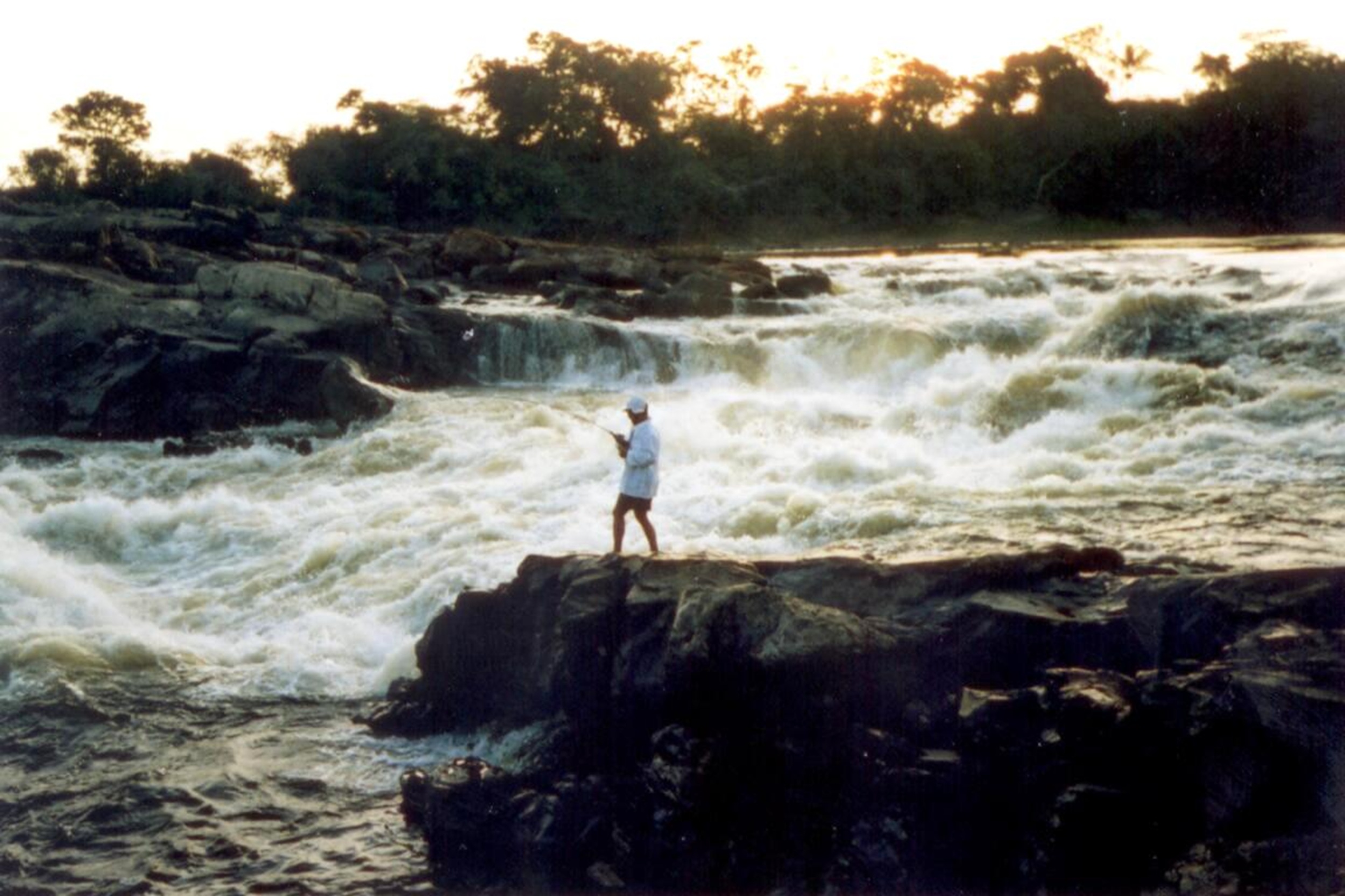
At the end of the ascent we could see a gentle river and an Amazonian landscape, different types of vegetation with wide shades of green and multiple species of birds, but the tranquility would last little. As we advanced, the mother of all falls appeared before us, imposing, white, and furious, the place where all legends had been born. We had arrived at Uraima Falls, the home of the giant Payara.
Once in the turbulent waters of Uraima Falls, Luis explained the mechanics of fishing. He told us that if we wanted to set a record, we should troll in the turbulence. Well, that's what we were here for, and at that point nothing was going to stop us. We put on our Rapala CD 18s and began our search. We didn't wait long: two simultaneous strikes. I had one fish and Rafael had another. I didn't know if the tremendous strength of this fish was increased by the strong current, but our effort was evident. I was losing yards of line in seconds, just like Rafael. Luis shouted orders to the captain to pull the curiara away from the falls. He was always very attentive to our safety above all. Rafael and I kept fighting with two specimens that we hadn't yet managed to spot. I managed to recover several yards, but somehow this fish gained strength and pulled out line again, making me lose all the previous effort. Rafael decided to play a little without reeling in line but maintaining pressure; his rod was doing the work. I, on the other hand, made a serious mistake: I decided to get off the curiara on the riverbank and I hurried too much. A silver fish jumped in the distance as if saying goodbye to me, but Rafael continued in the fight. A spectacle was about to unfold before us: an enormous silver Payara began a series of acrobatic jumps, accompanied by intense runs in different directions. Rafael's reel seemed to fuse with the action. Luis decided to navigate downstream, since on the shore it would be very difficult to maneuver this enormous fish due to the number of rocks, and we didn't want to lose it.
Suddenly Rafael told us "it's gone," and suddenly a new explosion of force took several yards of line; it was a back and forth. Rafael slowly reeled in; little by little we would see how that enormous fish gave in. Rafael brought this specimen closer and closer to the curiara. My greatest surprise was when I saw an enormous silver body with immense fangs emerge from the dark waters. Luis asked for help and between the two of us we managed to land it: a millennia-old payara was before our eyes. Once in the boat the payara made a noise like a cry of rage. Surprisingly, Rafael had landed a giant Payara of an impressive 32 pounds; I had never experienced anything like it. Truly, it was a fish that deserved our respect, and we carefully returned it to the water to perpetuate this spectacular adventure through time.
We had finally done it. We lived a legend and witnessed a fight we never imagined finding. Many have been defeated by these worthy adversaries, but for us this trip had transformed into a great victory.